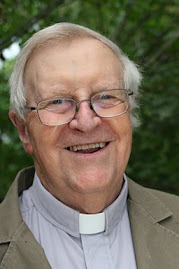
All Saints' Church, Rehoboth, Delaware. February 25, 2007
Readings for Lent I: Deut. 26.1-11; Rom. 10.5-13; Luke 4.1-13
We don’t often get a reading from the Book of Deuteronomy: even its name was a sort of conundrum until T.S Eliot’s poems appeared in a musical featuring one of his favorite feline friends. The name comes from two Greek words, “second” and “law”, and biblical scholars since the middle of the nineteenth century have understood it to be a reissuing of many older traditions, not only laws but summaries of Israel’s history and exhortations to a full acceptance of the religion of the One God, Yahweh. The book is in many ways different from the first four books of the Torah because it was produced under the influence, not of the scribal, priestly group, but by the followers of the Prophets, therefore emphasizing the need for social responsibility, and downplaying sacrificial rituals.
Its interest in the nation's history is well illustrated in today’s snippet, where the Book’s authors assume that Moses is speaking; this, by the way, was not regarded as forgery, for in ancient literature it was legitimate to say for someone centuries later what they might or ought to have said. The putative Moses speaks: “A wandering Aramean was my ancestor; he went down into Egypt and lived there as an alien, few in number, and there he became a great nation.” Then follows one of several potted histories that we find in Deuteronomy and the book of Joshua, more or less, its companion volume. From this passage and from a myriad others in the O.T. it is clear that the recalling of their history was central to the existence of Israel, and central to that story was a faith in the God who had brought them into existence.
As their history progressed, however, all did not go well. More and more they related how God had made them a chosen people, with the increasingly clear corollary that God was not interested in the other 99% of the world. They listened to part of their history and they ignored voices which reminded them that God had chosen them to be “a light to the nations”. Perhaps their exclusiveness is understandable, because their history showed them the implacable evil of the power of the great as they were, time and again, subjugated to powerful empires. At the same time, their prophets had to remind them that within their own society, the power of the rich and great caused immense suffering within their own nation. The frequently quoted wisdom that “those who do not take note of their history, are condemned to repeat it”, is not entirely true of Israel. They repeatedly took note, in many passages like today’s first lesson, and in many of the Psalms; the problem was not a failure to read, but a misreading of their history. There is much more that can be said, but we need to turn to today’s gospel and consider Luke’s version of the beginning of Jesus’ ministry.
Luke is more interested in what he takes to be a precise historical setting than any other Evangelist, indeed, of any other N.T. writer. At the very beginning he places the narrative of John the Baptist’s father “[i]n the days of Herod, king of Judea”; when Joseph and Mary have to go to Bethlehem for the census, he very precisely notes who was the Emperor and who the governor of Syria, and he carefully places the beginning of the Baptist’s work: “in the fifteenth year of Tiberius” when Pontius Pilate was governor and Herod [not “the Great”] tetrarch of Galilee. After the story of the baptism that follows today’s reading Luke notes that Jesus “was about thirty years of age”, and then gives one of the two (differing) genealogies, family histories of Jesus; the other one is at the very beginning of Matthew’s gospel. These passages are totally ignored by the Lectionary, and so only bible students tend to know even of their existence. They are however of immense and primary importance for understanding the objectives of the two writers. Matthew begins with Abraham, and comes, interestingly to Joseph. Jesus is clearly a Jewish Messiah. Luke, on the other hand begins with Jesus, supposedly the son of Joseph, and goes back 76 generations to Adam, noting David and Abraham on the way, and ending, “son of Adam, the son of God”. So Luke looks back on the history of Israel and sees Jesus as the son of Adam, that is human kind, and via humankind, the son of God.
There is continuity here, but also a startling break. Jesus, Luke seems to suggest, gives us an opportunity for a new history. He is a new Adam, a new humanity a new son of God. It is clear that this not an eccentric idea peculiar to Luke: Paul calls Jesus a second Adam in the letters to Rome and Corinth (Ro. 5.14; I Cor 15, 22 & 45), and even more strikingly proposes a new creation brought about by Jesus, the Messiah (II Cor. 5.17).
Such a view of Jesus disallows the reading of Israel’s history as an inclusive chosen race; it embraces, on the other hand, the Prophetic vision of Israel as a “light to the nations", and with this in mind we might take a new look at the temptation story given us by Luke. The context is vital. We have seen what immediately precedes this story (the lineage of Jesus) and we should note what immediately follows when Jesus emerges from his desert retreat. Luke says he came out “in the power of the Spirit”, went to the Synagogue in Nazareth, read from the Prophet Isaiah, proclaiming the work of the Servant of Yahweh to bring good news to the oppressed and freedom to those who are enslaved (Isa. 61. 1-2). Then the dramatic statement, “today this scripture has been fulfilled in your ears” (Lk. 4.20).
The testing in the desert has a triple thrust. Considered as ways to start a new history they might look something like this: start the new history so that it will be a record of social action, feeding the poor. Or, secondly, begin a new history where power can be used for good and you will not repeat the errors of the past. Then finally, establish yourself as the king who has within himself the divine power to write a theocratic history.
For Luke, the issue is not whether Jesus is the Son of God, but what kind of son. The Devil in these scenes is much more like the Satan of the Book of Job. There, Satan is a rather shady character on Yahweh’s Council of Advisors: rather like the Head of MI5 or the CIA. So the Devil’s function is not so much to tempt (in our contemporary usage) to sin, but to test the character and the will of God’s servant. The answers that Jesus gives tell us both how Luke thinks of Jesus and how he as the new Man will inaugurate a new trajectory for history.
Can it be an accident that all the answers are quotations of or allusions to the Book of Deuteronomy? They point to the divine plan that Israel has not yet managed to put into action. God, and God only must be at the center. Social action is required and is noble, but it must be subordinate to perpetual awareness of our absolute dependence on the gracious God and we must have a conviction that life has a spiritual dimension as well as a material. [That is to say, ‘we cannot love by bread alone’].
The answer to the second test is a refusal to embrace political solutions and to engage in power plays, but it is the final test and answer that clinch for us who Luke thinks Jesus was and what Luke thinks Jesus’ mission is.
The third answer is based on Deuteronomy 6.16, which refers to Israel’s rebellion while in the Wilderness. It underlines the obedience of the new Son, the new Adam, in contrast to the disobedience of Israel. It also suggests, again, the centrality of God: Jesus preaches the Kingdom of God, not the kingdom of Jesus. To put it another way, Jesus is to be the author of the new history: he is not to be its central theme.
As we look back at the history that actually evolved, we have to wonder whether not heeding our history is condemning us to repeat it. The church has had an irresistible itch to get into power plays; the church has had the conviction that it alone has access to truth, and, thus, the right to decree who is in and who is out, and the wrangles of theologians over who exactly Jesus is, have obscured the centrality of God and the work of God’s Servant.
Yet, there is also cause for rejoicing that renewal does happen, that reformation is possible and Easter, for which this Lent is a preparation, declares that Resurrection, life from death, is part of God’s plan, bringing order from chaos, and the continued possibility of a new history.
Sunday, February 25, 2007


Saturday, February 24, 2007
Darwin, Evolution and the Churches
Lecture 4 in ALL series – Science, Religion & Literature in 19th Century
It might be best to begin by saying something about the plural in the title of this lecture. This will involve briefly covering some of the ground with which I began our introductory lecture.
The religious scene in mid nineteenth century Britain is complex and often confusing. The Church of England was “by law established”, and its polity was very much intertwined with the state. Parliament was (and still is) the final council of the C of E., the existence of which goes back to Parliamentary Acts, supplemented by orders in Council by the Monarch (as in the issuing of the Prayer Book of 1559). It was the achievement of Elizabeth I to give some sort of settlement to this new national church, which had definitively separated from the jurisdiction of the Pope, and yet retained many “catholic” elements: Episcopacy, a fixed Liturgy, the so-called ecumenical creeds and a spirituality closer to the Fathers than to the European reformers. At the same time, there were many influences from the Continental reformation: married clergy (thought Elizabeth herself disapproved), vernacular services, a rejection of many ”popish” doctrines, particularly prayers for the dead and the whole structure of Purgatory.
The Elizabethan Settlement held, but only just. There were enough dissatisfied reformers who wanted to go much further both in doctrine and practice. They triumphed briefly during the Commonwealth with Cromwell as Lord Protector (1649-1660). James II took things in the other direction and tried to restore the authority of Rome, precipitating the Glorious Revolution of 1688. For almost two centuries a relative balance obtained. The Test and Corporation Acts excluded Dissenters from public life and the number of RCs dwindled. By the beginning of the 19th century, however, reform was becoming urgent. In 1828 the Test Act was repealed and 1832 the first Parliamentary reform act was passed. The removal of the Test Act allowed dissenters to stand for Parliament and a significant number were returned in the election after 1832.
The Free Church Groups
The Baptists were the biggest group outside the C of E, followed by Congregationalists; Methodists did not officially break from the established church until Wesley’s death, and did not begin to grow until well into mid century, but together those outside the church began campaigns to remove remaining impediments: marriage to be allowed in ‘chapels”; new civic burial grounds; the removal of church rates, which took until 1868, and finally, education. Measure after measure to admit nonconformists (as they were now being called) to the Universities met prolonged opposition. When finally a law was passed inb1854, Dean Burgon, a dinosaur if ever there was one, wrote: “Oxford, I fear, has seen her best days…She can never more be…the great nursery of the Church. She will become a cage of wild beasts at last….and the Church (and Oxford itself) will rue the day when its liberties and its birthright were lost by a licentious vote of a no longer Christian House of Commons.” (Quoted in Vidler, The Church in an Age of Revolution, p. 139).
Although the cries of pain and rage over new knowledge came from all Christians at first, the strongest opposition came from nonconformity and the Evangelical group within the C of E. It was because, on the whole, they had not begun to come to terms with a revised reading of the scriptures. Whereas, increasingly by the mid century, liberal clergy and Dons would say that you did not have to believe that Jonah was swallowed by a big fish and survived, or that the world was actually created in six days, lay people, especially dissenting lay people held fast to an inerrant bible.
The Origin of the Species
Into this mix came Darwin’s Origin of the Species. As we have seen, this was by no means the first airing of such views. Nor was it the cause of the first waves of doubt in the century, which had come from Geology and the critical study of the Bible. It was, however, the event that became the symbol of what seemed to the faithful the accelerating erosion of the faith. Its thesis was elegant and accounted for observations that had been accumulating since the time of Lamarck. Darwin had in 1844 produced a long and carefully argued statement of the evidence and the theory which “included nearly every detail of the final theory” (Asa Briggs, p.481), but he hesitated to publish and was only persuaded to do so when he learned that, quite independently, A.R. Wallace had reached virtually identical conclusions. So he produced the book, frequently characterized as “one of the most important books of the nineteenth century”. Its opening was in itself enough to add new shocks to storms rolling over the religious and social scene. “The view which most naturalists until recently entertained, and which I formerly entertained - that each species has been independently created - is erroneous”. The first part of the book draws conclusions from the facts of selective breeding: the work of horse breeders and pigeon fanciers. He then detailed a mass “of detailed and carefully checked information.” (Briggs, p. 482). Not only were the species not fixed, but the changes could be accounted for by the ‘relentless struggle for existence’, so a selecting process, the famous ‘natural selection’, determined the emergence of new forms ‘under the complex and sometimes varying conditions of life’.
Reactions - Scientists
It is important to recall that the cries of horror came from scientists as well as theologians. Darwin’s geology professor, Adam Sedgwick, was appalled; he wrote that “there is a moral or metaphysical part of nature as well as physical and that a man who denied this (as he assumed Darwin was doing), was ‘deep in the mire of fallacy’” (Briggs, p. 483). Sir Richard Owen was the most prestigious, but not the only scientist to take a stand against Darwin’s theory. Perhaps, more significant is that the popular view that all scientists in the nineteenth century were agnostic or even atheist just cannot be sustained. Chadwick points out that scientists were highly educated people, “and if they were told that science ‘disproved religion’ they knew that it did not. Most of them jettisoned belief in the historical information of Genesis before they knew about evolution.” (Chadwick, II p.6). Of course, it was precisely in being able to jettison the older reading of the bible that differentiated most scientists from the defenders of dogmatic theological positions. This is a phenomenon that can be studied at first hand in our contemporary culture!
Huxley is reported to have said several years after the original uproar that, without any doubt, if a general council of scientists (to transfer ecclesiastical terminology) had been held in 1860, “Darwin’s views would have been condemned by an overwhelming majority.” As it was, Asa Briggs points out it was not the church scientific, but the Church Militant which was first off the mark.
Reactions - The Religious Establishment
Among the leaders of the religious establishment, the alarm was palpable. Samuel Wilberforce, Bishop of Oxford became the spokesman for the opposition, and began the attack with an article in the Quarterly Review. He maintained “that Darwin was guilty of ‘a tendency to limit God’s glory in creation’; that ‘the principle of natural selection is absolutely incompatible with the word of God’; that it ‘contradicts the revealed relations of creation to its Creator’; that it is a ‘dishonouring view of nature’, and so on” (Vidler, op.cit. p. 117). Basil Willey reminds us that Bishop Wilberforce was not an eccentric, clinging to traditional positions long gone. Rather, he was a typical exponent of the ‘broad principles on which the Protestantism of Englishmen rests’. Wilberforce had become the leading champion of moderate but rigid High Churchmanship against the dangerous forces of liberalism. (Willey, More Nineteenth Studies, p.167). I suppose that everyone knows the story of the clash between Huxley, Darwin’s great champion, and Bishop Wilberforce at a meeting of the British Association in 1860; it is, however, too good not to tell yet once again. The several reports of the meeting do not all agree in detail, and tend to paint Wilberforce as an ignoramus, but this was not universal as Darwin himself admitted:
“Darwin himself thought Wilberforce's criticisms fair or at least faceable. `I have just read the "Quarterly" ' he wrote to Hooker in July, 1860. `It is uncommonly clever; it picks out with skill all the most conjectural parts, and brings forward well all the difficulties... A letter to Lyell on 11 August is significant:'... This morning I recommenced work and am at dogs; ... By the way, the Bishop makes a very telling case against me, by accumulating several instances where I speak doubtfully; but this is very unfair, as in such cases as this of the dog, the evidence is and must be very doubtful.' Darwin's first work, on recovering his health, was in the areas picked out as weak spots of his theory by Wilberforce.34 At the same time he is beginning to be more critical of Wilberforce's criticisms, as being unreasonably stringent in view of the inevitably doubtful nature of the evidence. Huxley had made this point at the outset. “ (Web Article: The Encounter R.J. Lucas).
Two points need to be made: firstly, Darwin is talking about the review article here, and it is more than likely that the Bishop’s language was less measured in a debate; and, secondly, once Darwin’s theory was in the public realm, it gave new direction to researches (you don’t see what you are not looking for), and many gaps soon began to be filled. It has taken a century for genetics to give us the final clincher.
The Wilberforce-Huxley Encounter
Still, all this being allowed, it remains true that the main issue was the strongly held view that the Bible gives us accurate factual knowledge and with that firmly held position, a theory of evolution however water-tight would have been (and still is) attacked. So to return to the British Association meeting, the most likely account goes like this: Wilberforce appears to have said to Huxley, “If anyone were wiling to trace his descent through an ape as his grandfather, would he be equally willing to trace his descent similarly on the side of his grandmother?”. This reflects a very sentimental Victorian attitude to women. Huxley is said to have muttered to his neighbor quoting the O.T., “The Lord hath delivered him into my hands", and the report of his answer was: “If …the question is put to me, would I rather have a miserable ape for a grandfather or a man highly endowed by nature and possessed of great means of influence and yet who employs these faculties and that influence for the mere purpose of introducing ridicule into a grave scientific discussion – I unhesitatingly affirm my preference for the ape.” Whereupon there was inextinguishable laughter among the people.” (Quoted in Chadwick, II p.11).
Monday, February 19, 2007
The Faith/Doubt Scenario Lecture 3
I broke off last week somewhat in the middle of a consideration of the impact of Geology and, in particular,
Charles Lyell’s significant contribution in his two volume Principles of Geology.
Lyell upset the biblical time scale irremediably, but worse was to come. His thesis gave a rational explanation of why fossils of sea creature could be found on the top of mountains, without recourse to a Noachian flood of immense proportions. It also made clear that many species had perished, a notion totally unacceptable to long-held views about the immutability of the species. “The inhabitants of the globe”, he wrote, “like all other parts of it are subject to change. It is not only the individual that perishes but whole species.” (Quoted in Basil Willey, More Nineteenth Century Studies, p 84). This phrase is virtually quoted in stanzas LV and LVI of the poem, and we know that in 1837, Tennyson was ‘deeply immersed’ in, and troubled by, a study of Lyell’s work. That the species are ‘subject to change’ shows that what one might call proto-evolutionary ideas were around decades before Darwin published.
Vestiges of Creation
They were suggested in 1844 (though without Darwin’s meticulous work that explained the precise mechanism of change) in a somewhat cranky book published in 1844, The Vestiges of Creation. It was published anonymously and occasioned wild speculations about the identity of the author: Prince Albert was a favorite candidate but speculations also suggested Lady Lovelace, Byron’s daughter, Thackeray or even Charles Darwin who was thought to be writing something in this field. The book was a very mixed bag: its central thesis was more or less in line with ideas that were beginning to percolate to the reading public, but also contained a mish mash of fable and hearsay: spontaneous generation of life by passing an electric current through inorganic matter; the possibility of hatching a rat from a goose egg; and wild pigs do not get measles, so measles in humans result from eating bacon (from domesticated pigs). (Chadwick TVC I, p. 565f.) The book writes Chadwick, “embarrassed serious students of evolution. It embarrassed literate Christian geologists because it encouraged illiterate Mosaic cosmogonists…The book embarrassed the tiny handful of serious students working towards a tolerable and scientific theory of organic development. Huxley never forgave Chambers (for that was the author’s name. not revealed until some time after his death) for making truth ridiculous.” (TVC I, p.566).
Whereas Tennyson was greatly troubled by Lyell’s work on geology, what Robert Chambers (much later revealed as the author) had to say seemed reassuring. Quite apart from the ludicrous claims, Chambers fell back on the older arguments. God worked through the ‘natural laws’ he had established, and “what is to hinder our supposing that the organic creation is also a result of natural laws, which are in like manner an expression of His will?”
Analytic & Critical History
The other great cause for outrage to traditional positions came, as it were, from within, particularly from German biblical scholars. In the usual accounts of the impact of science on religion, the focus tend to be on the natural sciences, geology, physics, biology and, though, often forgotten, astronomy. [See Norton Ed. of In Memoriam, pp. 147 ff. with interesting lines from The Princess. In the light of this, it is important to note that the approach to history and history writing had been undergoing a sea change. Methods analogous to the empirical approach of the natural sciences began to be used. Texts were analyzed with statistical probabilities in mind; traditional attributions of authorship were, therefore, often called into question, and forgeries revealed What might be called a scientific approach to history and ancient documents did not begin with the biblical texts, but with classical. Students began to ask about, for example, the Odyssey: did it really represent an early stage in Greek history? Was it by a single author? How did it compare with other great orally transmitted epics and so on.
The Old Testament
As early as the late 18th century, scholars began to turn their attention to the Hebrew scriptures, beginning with the first five books of the bible known as the Pentateuch. Both Jewish and Christian tradition was in no doubt that all five were written by Moses, and it was this article of faith that was first to go. Critical analysis revealed that the books were a composite of at least four documents though later students preferred to speak of “traditions’, and to consider more than four). These theories explained facts that earlier generations had ignored, and problems that had been rationalized away. Preeminent was a new understanding of why so many incidents and stories appeared more than once. Perhaps the most striking example is the two creation stories right at the beginning of the Book of Genesis: it appeared that the very first chapter of the book was probably almost the last piece to be written as the Pentateuch reached its final form after many editings. Of course this was only the beginning: the prophetic books, the Psalms and the records of the later history of the Hebrews in the books of Kings and Chronicles were soon subjected to minute inspection and, indeed, dissection. Not surprisingly, in the flush of enthusiasm for a whole new understanding of the scriptures, some rather wild theories were propounded, giving the beleaguered traditionalists a few straws to clutch. Chadwick writes, “Germany entered this phase in the history of ideas nearly half a century earlier than England. On his arrival Prince Albert cold not help regarding English clergymen a obscurantist.” (TVC I, p.530).
Allegory & Moral Objections
The reaction in England was somewhat delayed partly because few academics thought it worthwhile to learn the language, and those who did and showed some interest in and sympathy for the new ideas clearly were regarded by the Oxbridge/Cathedral axis of power as suspect at least and as heretical at worst. The Old Testament has in some measure been a problem from the start: the 3rd century commentator, Origen, struggled with the law that Christians clearly did not any longer keep, and turned to allegory: shell fish really referred to sensual sins that clung lie a limpet. its stories of Joshua killing all the Canaanites, Jepthah sacrificing his daughter because of vow to Jehovah (Jud. 11.30 ff.),and the generally war-like and revengeful character of the said Jehovah. By the way, the very name Jehovah was shown to be an absurd reading of the Hebrew text, resulting from putting together the consonants of the name of God revealed to Moses, YHWH, with the vowels of aedonai (Lord). The vowels were written above Yahweh to remind the reader not to utter to sac red name.
The New Testament
Still, the Old Testament was one thing, the New quite another matter and it was not long before the waves of radical criticism were lapping at the very rock on which the church was built, at least from a Protestant perspective. Slowly the new critical views filtered through. George Eliot’s translation of one of the seminal works, The Life of Jesus by D. F. Strauss, certainly did a good deal to raise the anxiety level. As Owen Chadwick says: “The unsettlement of scholarship-and also of the public mind was greater over the New Testament than over the Old…because it touched the centre of Christianity”. (Victorian Church II, p. 60). That the First five books of the O.T. were shown not to be by Moses, but to be made of multiple sources of varying dates several centuries after his death (even if that could any longer be dated at all), was unsettling, but to be told that the four gospels were almost certainly not by the Evangelists to whom they are attributed, that Jesus made mistakes of fact (e.g. David wrote the Psalms) was devastating. As time went on the rear-guard actions of conservative scholars looked less and less credible, but for more than the first half of the century, all this shook up faith and strengthened doubt.
There is nothing in In Memoriam that seems specifically to refer to the corrosive effects of critical, historical, criticism in the way Tennyson’s passages about geology and evolution do, but the turmoil in Lecture Room and Pulpit contributed significantly to the growing cloud of doubt that one frequently feels swirling round as one reads.
Friday, February 09, 2007
Fading Faith & Honest Doubt - Lecture 2
Introduction
Alec Vidler in his excellent short volume in the Pelican History of the Church series (V), quotes Margaret Maison (Search your Soul Eustace, p 209): “Never has an age in history produced such a detailed literature of lost faith, or so many great men and women of religious temperament standing outside organized religion”. (Vidler p. 113). Alfred Tennyson does not quite fit into the category of lost faith, but from his Cambridge days on and in most of his writing the issue is often near at hand. Some close friend, perhaps Emily Sellwood, whom he was eventually to marry (after a broken engagement of over a decade), tells him “doubt is Devil-born”, to which he responds that his great friend Hallam was “perplext in faith, but pure in deeds”. Then follows what have been, perhaps, the most quoted lines of In Memoriam:
Lives more faith in honest doubt
Believe me, than in half the creeds (XCVI, 11 & 12).
Tennyson was not fully in the company of the likes of Thomas Carlyle, George Eliot, John Stuart Mill, and many others who quite publicly rejected traditional and established Christianity, while often, we need to be reminded, retaining what might be called a generalized religious temper of mind. Morality remained paramount, but its necessary connection to religion, and especially the traditional view of many orthodox believers that rejection of a Christian position inevitably led to immorality, was vehemently rebutted. T.S Eliot’s justly famous essay on In Memoriam, proposed the often quoted view that the poem is religious in tone, not “because of the quality of its faith, but because of the quality of its doubt. Its faith is a poor thing, but its doubt is a very intense experience.” (Quoted in the Norton critical Edition of In Memoriam, p. 138). One hesitates to take issue with so great a name as Tom Eliot, but a sorely tried faith, a faith that recognizes that it is under attack and honestly faces up to the truths behind the attack, is perhaps more than a “poor thing”. In Tennyson, one feels, that the conflict is in progress whereas in so many of his intellectual contemporaries it was taken for granted that it was over and religion lay in its final throes. Without doubt, Tennyson’s faith was far removed from Nicene-Chalcedonian orthodoxy as the very final stanza of the poem suggests (note the neuter, “which”):
That God* which ever lives and loves
One God, one law, one element,
And one far-off divine event,
To which the whole creation moves. *(in whom AHH now lives)
The Intellectual Scene as the 19th Century began:
Causes of the Convulsions
We have seen some of the factors that led up to the nineteenth century intellectual convulsions, a scene well illustrated by Simon Winchester in his book, The Map That Changed The World; pages 11-16 give a good over-view.
We now need to consider in more detail some of the specific writing, controversies and strongly held positions. A great deal of the “battle” raged in the newspapers and journals of the day: the Quarterly Review, the Edinburgh Review, The Christian Observer, The Guardian, and, of course, The Times. The discourse was frequently unmannerly and strident. The most strident voices came, on the whole, from the defenders of tradition, Bishops, Deans and Dons. Alec Vidler has an excellent comment on this situation:
It may also be surmised that the strident tones and proclivity to heresy-hunting…characteristic of many Victorian divines may have hidden from themselves as well as others…anxiety about their own faith…Men talk with shrill excitement when they are least sure of themselves and most fearful that those who disagree with them may be right. (op.cit. p. 113).
From where did the defenders of the Faith perceive the threats to be coming? By and large they had come to some kind of rapprochement with the Copernican and Newtonian revolutions. The universe might be a massive and intricate machine, but it was one created by God, and the architects of the new world-view were almost all at least Deists, and remained fully involved in the life of the church. It is worth recalling that Newton wrote more pages of theology and commentary (particularly on the Book of Revelation) than on all scientific, writings in physics, mathematics and astronomy.
So what was it? Two main areas of debate were emerging as the nineteenth century opened. The first was the field of the Natural Sciences where the rate of discovery based on empirical observation moved into high gear. The second, more immediately threatening, because it seemed like an attack from within, was the rapid expansion of a critical, historical approach to the Bible. What was being discovered and written about in these fields added to the disquiet already voiced by men like Carlyle, about the morality of a God portrayed in the Old Testament: there was, too, among many thoughtful people an increasing unease about traditional atonement theories which seemed to suggest an angry father demanding the punishment of an innocent son.
The Emergence of Geology
It is commonly assumed that the focus of the great debate was the work of Charles Darwin, whose decades of patient research and observation resulted in the publication of The Origin of the Species in 1859. The facts show otherwise. The well-known stanzas LV & LVI demonstrate that views about evolution were current long before Darwin published, written as they were in the early 1840s. But long before the major battle over evolution began, another branch of science was causing immense anxiety to the traditionalists. It was the work of the early geologists, making a major appearance in the poem in stanzas LVI & CXXIII, for example, which really began to rock the boat of faith at its moorings.
Geology was a new science at the beginning of the 19th century: the third edition of Enc. Brit. 1797 had no entry for it, but by the time of the fourth edition in 1810 a lengthy article is found. Many factors lay behind the emergence of this new interest in the formation of the earth. Suggestions were being made that the shell-fish like stones that were frequently picked up as a farmer ploughed might even be organic in origin: their named changed from “figured stones” to fossils; the frenzy of canal building in the late 18th and railway building in the early 19th centuries exposed deep cuttings which to one or two ingenious minds suggested strata of differing kinds, rock, pebble, marl and so on; so on, particularly, to coal deposits, which were discovered to be much more vast than those exploited since Roman times. The seams needed to be identified and the canals were needed to carry the coal to the new industrial centers at half the cost of a horse wagon and much more quickly. In many ways the economic factors facilitated the scientific enquiry that followed.
Collision with the Bok of Genesis
The data thus revealed were the basis of the new science, and its most complete exposition to date was given by Charles Lyell, later, Sir Charles, who between 1830 and 1833, published the two volumes of Principles of Geology. The main thesis was that the present state of the earth’s surface could not be accounted for by current theory, mainly that of the “catastrophists”, which posited a series of immense upheavals over a rather short period (to fit in with the biblical time-table established by The Book of Genesis, of which, more later). It was to be explained, rather, by the continuous operation of natural forces like wind, tide, volcano and earthquake over protracted periods of time. Here was the most startling clash with biblical data so far in the history of science. Galileo’s observations about the moons of Jupiter did not explicitly contradict the bible and Newton’s mechanical universe could be fitted into a theistic scheme. But tens of millions of years since the creation: that was impossible. Had not Bishop Ussher of Armagh in his erudite and prolix Annalis Veteris et Novi Testamenti of 1658, shown conclusively that the first day of creation began at 9.00 a.m. on Monday, October 23, 4004 B.C.(E.)? Lyell’s time-table, if correct, overturned Genesis, and that was an affront to the almost universally held views about the authority of the bible.
Winchester has an interesting footnote to page15 relevant to this:
Few outside the world of rigid Christian fundamentalism today accept the strict interpretation of Ussher’s arithmetic…[but] a 1991 survey showed that fully 100 million Americans [he means the USA!] still believed that “God created man (sic. )pretty much in his own image at one time during the last ten thousand years…This might suggest that aspects of the religious climate into which William Smith was born-and that he was to help start changing-are now starting to return.
Immutability of Species
Lyell upset the biblical time scale irremediably, but worse was to come. His thesis gave a rational explanation of why fossils of sea creature could be found on the top of mountains, without recourse to a Noachian flood of immense proportions. It also made clear that many species had perished, a notion totally unacceptable to long-held views about the immutability of the species. “The inhabitants of the globe”, he wrote, “like all other parts of it are subject to change. It is not only the individual that perishes but whole species.” (Quoted in Basil Willey, More Nineteenth Century Studies, p 84). This phrase is virtually quoted in stanzas LV and LVI of the poem, and we know that in 1837, Tennyson was ‘deeply immersed’ in, and troubled by, a study of Lyell’s work. That the species are ‘subject to change’ shows that what one might call proto-evolutionary ideas were around decades before Darwin published. They were most clearly articulated (though without Darwin’s meticulous work that explained the precise mechanism of change) in a somewhat cranky book published in 1844, The Vestiges of Creation. It was published anonymously and occasioned wild speculations about the identity of the author: Prince Albert was a favorite candidate among many others. Whereas Tennyson was greatly troubled by Lyell’s work, what Robert Chambers (much later revealed as the author) had to say seemed reassuring. Chambers fell back on the older arguments. God worked through the ‘natural laws’ he had established, and “what is to hinder our supposing that the organic creation is also a result of natural laws, which are in like manner an expression of His will?”
The other great cause for outrage to traditional positions came, as it were, from within, particularly from German biblical scholars, and we will take this up in the next lecture.
Friday, February 02, 2007
Religion & Science in 19th Century Britain
I am currently teaching a course for an Academy of Life Long Learning dealing with the debate/conflict between science and religion in mid nineteenth century Britain, particularly as reflected in Tennyson’s poem "In Memoriam A.H.H." Here is the general introduction to the course; I hope to add further, shorter notes as the Semester progresses:
The Wider Background
There is widespread agreement that the first half of the 19th century was an era of significant distress and disruption, socially, politically, and, above all in religious belief and practices. Our ultimate objective is to provide the setting for Tennyson’s monumental work, In Memoriam, which reflects many of the tensions so often lumped together as the “science and religion” issue: to do this, however, we need to go back to earlier settings. The tensions and turbulence hardly erupted out of a clear sky, and, to get a good understanding of the turmoils that engulfed the mid-Victorians, it will be helpful to look at some of the clouds that were already gathering long before the eighteen year-old Victoria came to the throne left vacant by the death of her Uncle, William IV.
Any procedure along these lines at once poses the question: how far back can we, should we, go? Perhaps we can take for granted that immense changes began at the Reformation, ending it as it did centuries of a more or less monolithic order for all of Europe. It is easy to assume that the Reformation brought monumental changes to the religious scene, and in some ways that is accurate, but at the deeper levels of theological principles, and, particularly, what might be called the foundational Christian positions, there was not all that much change (except, perhaps, in the case of Calvin who ratcheted up the Augustinian position quite a few notches): views of God as Unity in Trinity; of Jesus Christ as human and divine whose death continued widely to be understood as some punitive transaction that freed humankind (and both sides in the post reformation era continued to say “mankind”); of heaven and hell (though Purgatory had a rough time in Protestant circles); the view that the earth was created in 4004 B.C., this and much more remained unchallenged. The main changes in the reformed position were the new understanding of the structure and authority of the church, and, almost as a corollary to that, the status of the scriptures, where an infallible book now took the place of an infallible Pope or Council of Bishops.
The Age of Reason
It was, however, these two factors that were central in the intellectual developments of the 17th and 18th centuries. The almost universal consensus of the mediaeval period gave way to new questionings of the fixed and final authority of the Church/State of the 12th-15th centuries. Copernicus and Galileo led the way, but lest this introduction to the period with which we are concerned turn into a full-blown history of the Renaissance and the rise of science, it is necessary to jump a century or two.
As we over-fly the territory, we should note how two Englishmen dominated European thought from the 1680s on. Gerald Cragg writes, “In the early part of the eighteenth century, the prestige of English thought stood very high. This was largely due to ….two men: Isaac Newton, who had unlocked the secrets of the physical universe, and John Locke who had laid bare the inner nature of man. English ideas, when transplanted to continental countries, often proved revolutionary in their implications.” (The Church & The Age of Reason 1648-1789 - Penguin 1960, p 157).
Since Newton’s pure reasoning had produced such an elegant and (apparently) final picture of how the Universe worked, it is not surprising that the century that followed has become known as the age of reason. The centre of gravity moved from its Newtonian home to France where thinkers like Montesquieu, Voltaire and Diderot worked at the diffusion of new ideas, producing the Encyclopaedia. Cragg writes: “[The authors] were not primarily interested in communicating a specific body of knowledge; rather, they aimed at effecting a fundamental revolution in the prevailing pattern of thought.” (op. cit. p 236). This they achieved in great measure, among the intelligentsia of Europe: there was a distinct move from accepting positions on ecclesiastical authority, a move to question accepted historical evidence just on the weight of its supposed origins (Edicts on which much Papal authority was based had been shown to be forgeries), and, in general, a move to a science that was free of theological presuppositions.
Long before the 19th century began, experimental science was asking questions and providing new answers. Quite a few of the aristocratic class had laboratories in their stately homes, Robert Boyle, whose law about the behavior of gasses is well known, is a good example, the earliest experiments with static electricity were under way and in medicine a few tentative steps were being taken. It was not only in the natural sciences that things were stirring. The very understanding of history was changing. New documents were coming to light, old forgeries were being exposed, and, above all, the first signs of critical history appear, where it becomes clear, for example, that the mere number of witnesses is no guarantee of accuracy.
Beginning of the Nineteenth Century
Thus, by the beginning of the 19th century much had changed since the end of the middle ages, and the stage was set for the clashes of what might broadly be called ‘secularism’ and the defenders of traditional religion. The situation in Great Britain, however, was significantly different from affairs on the continent. The whole of Europe was still staggering from the effects of French revolution; in Britain, this led to the strengthening of traditional positions, with a good many recriminations against liberals, and a determination to void such excesses. All this has to be viewed in the light of the struggle for survival being fought against Napoleon Bonaparte.
The Religious Scene
The wider religious scene at the beginning of the new century is as complex as its understanding is essential for our purposes. For much of the 18th century, the C of E could not be called a dynamic force in English life. It was decidedly Erastian in orientation, that is to say, there was almost a symbiosis between State and Church: The Convocations had lapsed and Parliament rarely dealt with church issues (that was to change significantly in the next century); the great Cathedrals kept the services going, but were hardly shining lights; in quite a few rural areas good parsons looked after the members of the parish, lamenting that there seemed to be an increasing number of Dissenters. But, still “[The Church of England] claimed to be a national communion, big enough to contain all shades of thought and feeling, with its rules and ordinances part of pour happy Constitution and State’.” (Asa Briggs, The Making of Modern England, p 69). Among churchmen (people), there was a lively and very present awareness that the English church was “as by law established”. Ever since the time of Elizabeth I there had been groups who felt that the English reformation had not gone far enough, some though no where near far enough. Some, by the time of James I, despairing of any change in the Royal support for the establishment had, to the great relief of many in England, had departed to the new world, taking with them strong Calvinist principles and a narrow vision of a New Jerusalem; there they were to become in future centuries one of the deeper religious strains in the developing of a biblical fundamentalism and an anti-scientific attitude.
Fears of ‘Popery’
At the other end of the spectrum, the establishment continued to fear the re-establishment of a Roman Catholic monarchy. Elizabeth’ reign was plagued with plots to replace her, perhaps the most well known being the one cooked up by Sir John Babbington, aimed at putting Elizabeth’s cousin, Mary (the Scottish Queen) on the English throne. But the threat did not end with the death of Elizabeth. There followed the Stuart kings, Charles I & II, bracketing the civil war and the decade or so of the Common wealth under Cromwell – clearly a time when the “More Reformation” party, (or more accurately parties) were in the ascendant. Charles II died n February 1685, reputedly proclaiming himself a papist on his death-bed. His son, James II, clearly wanted to restore the link with Rome and precipitated what is called the “Glorious Revolution” of 1688, which brought the Hanoverians into power.
Even this was not the end of the story. In 1715 and again in 1745 attempts were made to restore a Stuart in the throne. They both failed, but had results that strongly influenced the religious scene in England into the 19th century. Michael Wheeler writes, “ Protestant accusations the Catholics would ‘never peaceably submit to a Protestant government’ were often repeated I the n nineteenth century, especially in the times of crisis”. (The Old Enemies – Catholic and Protestant in Nineteenth-Century English Culture. CUP 2006, p 113). Among these crises were the gradual repeal of discriminatory laws, the re-introduction of Roman Catholic Bishops, and the perceived infecting of the C of E with ‘popish’ errors clearly visible in the defection to Rome (‘going to Aunty’) of controversial figures like Jon Newman, later made a Cardinal. Thus as we move into the 19th century we have the C of E. ‘by la established’, but on one wing a significant number of dissenters, suffering under penal laws of exclusion and on the other, a lingering minority, who lived with even bigger legal exclusions, and hankered after re-connecting with Rome.
Methodism
Asa Briggs remark that the established church managed to hold a very broad spectrum of theological opinion and ecclesiastical practice is certainly not over-stated. The center was occupied by what are frequently called “latitudinarians”, and though by 1800 they were more a hang-over of the rationalism of the previous century, they still minimized the speculative element in religious thinking and preferred moral duty to theological theorizings. The most dynamic group was the Evangelicals. The main evangelical movement had begun outside the C of E with the work of John Wesley who founded the “Methodist Societies”, but it took strong root within the established church, a minority movement but a very vocal one, inveighing against vice, insisting on a rigid keeping of Sunday (which they always mis-named as “the Sabbath”) and a general disapprobation of any kind of display in religion. As a result, outside their own circles, they were unpopular, accused of removing the few comforts that the working-man had (things like a pint of beer and a stroll in the Park on Sunday).. They were thought by most good, average Church of England members of the working class to be priggish and stuffy; (and, it might be added, by the vast majority of the upper and upper-middle classes); they would not have fox-hunting clergy, dancing clergy, idle clergy, academic-like preaching clergy. Nevertheless, their influence was immense. Marian Evans whom we know as George Elliott was brought up in a strongly evangelical household, allowed as a girl to read only censored versions of Shakespeare. This edition was produced by an evangelical clergyman, Dr. T(homas) Bowdler. It is possibly apocryphal and could easily be checked that Bowdler change the line in Othello, “Thy wife has played the strumpet in thy bed”, to (surely you guessed), “Thy wife has played the trumpet in thy bed.” Tennyson was brought up in a country Vicarage; his father was not an evangelical, but as a die-hard Tory had a very narrow view of life and an unquestioning loyalty to the dogmas of the reformed C of E.
Church of England – Evangelicals & Tractrians
The Evangelicals within the C of E remained fiercely protective of the established church: Chadwick writes, “Leading evangelicals were attached to the doctrine and discipline of the C of E. They exalted the prayer book, valued the establishment, [&] resented assaults upon a state church.” (The Victorian Church I, p 441). Another group, at deadly enmity with the evangelicals was not by any means as respectful of the establishment. They were the high church party, variously called the Tractarians (after a series of Tracts on theology and church polity that they wrote) or the Puseyites, after one of the leading Oxford Professors who was a major influence in their formation and continuing influence.
From the point if view of intellectual positions, the evangelicals tended from the start to an anti-intellectual stance: a trait that is still much in evidence among their contemporary descendants. The Tractarians, on the other hand, were much more scholarly, but it was a scholarship that stoutly resisted the trends of the 18th century and even more strongly what was to happen in the decades after1830. We tend to assume that only the evangelicals were, what since the early 20th century has been called Fundamentalists: the fact is that at the beginning of the 19th century almost all churchmen (as both halves of the human race were invariably called) held rigid views about the divine inspiration, and, thence, the accuracy of the Bible.
As we progress in reading In Memoriam, we shall revisit in more detail some parts of this background, especially considering the impact of the study of geology and Lyell’s Principles of Geology and an (at first) an anonymous work, The Vestiges of Creation, which appeared in 1844.
Brief Notes on the Format and Composition of In Memoriam
Alfred Tennyson was born in 1809, the fourth of what was to be a family of eleven siblings. The family history is even more convoluted than was typical for the English upper middle classes at the time. The Poet’s grandfather came from yeoman stock, but trained as a lawyer and became wealthy and, in his own eyes at least, the founder of a “county” family, that is, a substantial, land-owning Tory Squire (to whom his villagers were expected to touch their forelock). “By 1815 his properties at Grimsby alone were offered for sale at £200, 000 (about $1.8m in today’s currency), and at his death in 1835 he owned lands and manors all over northern Lincolnshire”. (Robert B. Martin, Tennyson – The Unquiet Heart Oxford 1983 p 7). Alfred’s father was the oldest son, but not the ‘old man’s’ favorite and was virtually disinherited. He was sent to Cambridge and ended up as the Rector of a rural Lincolnshire parish, Somersby.
Behind it all lay a family ‘secret’: there was a tendency for epilepsy in the Tennyson genes. At this time in history, there was some kind of stigma attached to epilepsy, almost as though it indicated moral degeneracy; for some quite inscrutable reason, its symptoms were attributed to gout. One of Alfred’s brothers was institutionalized from childhood, and several others became addicted to opium or alcohol in the efforts to control the seizures. Martin writes, “What is most probable is that among Alfred Tennyson’s ten brothers and sisters, some had attacks that resembled epilepsy”. (p 10) Alfred in later life thought he too might have the tendency and it was probably that fear, among many other factors, that delayed his marriage until he was 41. He records occasions of “trance-like” states, which were often important for his poetry. There is little doubt that for most of his life Tennyson suffered from depressive episodes and he tended to hypochondria.
He looked back on his early year in Trinity College Cambridge and the few years before that as a relatively happy time. His greatest joy was the friendship he made with a fellow Trinity student, Arthur Henry Hallam, two year his junior. Bernard writes, “The external circumstances of their lives were so different that it is surprising the most celebrated friendship of the century should ever have begun at all”. (p 69). It may not be surprising, however, that they met when both were submitting entries for the Chancellor’s Gold Medal for English verse in 1829. The two became close friends. Hallam visited Somersby, and enjoyed the informality of a large family. Eventually, he became engaged to Emily, Alfred’s younger sister. The friendship of the two men continued, and they took a memorable holiday together in Spain, involved in an amateurish plot to help some Spanish exiles over-throw King Ferdinand. The intrigue came to nothing, though they were put in some danger. The trip, however, was of immense significance to Tennyson and inspired one of his greatest poems, In the Valley of Cauteretz.
In 1831, Dr. Tennyson died after a rapid, though not unexpected decline. This put an end to Alfred’s Cambridge career, and he never did receive his BA. But he and Hallam continued to correspond and to meet from time to time. In the summer of 1833 Hallam and his father were travelling in Europe. On September 13 they were in Vienna and Arthur felt unwell; two days later he died of a brain aneurism, the result, it appeared from the post mortem, of a congenital vascular abnormality. Tennyson received the news in early October. Martin writes, “Unlike Emily, Alfred did not visibly sink under the weight of Hallam’s death…although it certainly affected him long after she had recovered from it...His one remaining resort was to poetry, used as a narcotic for an existence made temporarily meaningless. On the very day that Gladstone heard that Hallam was dead, Tennyson began the first of the lyrics he was ultimately to collect as In Memoriam”. (p 184)
In this way began a process that went on for nearly seventeen years; poems written in different places, occasioned by memories, anniversaries and recurring questionings about divine providence and the possibility of immortality, mounted up. Friends urged him to publish, but he remained reluctant. In the end he began to assemble the many pieces, providing the barest structure with three celebrations of Christmas and ending with the celebration of the marriage of Cecilia, one of his sisters, not, it may be noted that of Emily, who had been engaged to Arthur Hallam. The quirks of the final structure are clear when one notes that the Prologue was written at the very end after the compilation had been made, but the Epilogue, an epithalamium or ‘marriage song’, dates from 1842.
Saturday, December 02, 2006
Sermon for Advent I
Ever since I became aware of the meaning of Liturgy and the progression of the liturgical year, Advent has been one of my favorite seasons. The readings contain some of the more majestic passages of the scriptures, the music, the poetry and the theology are impressive. But as I thought about it, I was struck by the many contrasts of Advent.
There is the contrast that in the world around us, Christmas is in full swing while we in the church with purple vestments keep a season of penitence and preparation. The readings for Advent, too, abound in contrasts. The theme of future judgement is prominent, with images of earthquakes and apocalyptic flames; but at the same time, our attention is directed to the way we live our lives day by day, and judgement is seen more as a process than a future apocalyptic happening.
But perhaps the biggest contrast of all, and the one I want us to reflect on for a while this morning, is between settled traditions of the past and the uncertainties of the future. Advent is part of a magnificent, established round of liturgical worship. For me it brings with it remembered years, and echoing strains of "Come, O come Emmanuel" sung by a superb choir in a vast gothic cathedral, and it has about it an emotional tone of continuity and certainty which is linked in feeling and memory to Christmas. Advent looks in two directions. It gathers up all the longings of the People of Israel for the coming of their Messiah and in that it is a preparation for our celebration of the advent, the coming, of the Messiah child in Bethlehem. More insistently, though, it looks to the future, to the final coming of God’s rule, and in this way, the message of Advent points up the uncertainty of social conventions and institutions that look as though they are set for ever in stone.
Without doubt, the readings for today direct out attention to the future aspect of Advent:
The Old Testament sees history as a finite process, a flow of events and people which has a beginning in the creative act of God, and moves to an End. All this is summed up in the Book of Revelation, "I am the Alpha and Omega, says the Lord God, who was and who is to come, the sovereign Lord of all." (Apoc. 1.8)
Many pictures of the end suggest great trials and terror, but they also assure the Christian community that if it is faithful all will, in the end be well. Paul, writing to the Christians in Thessalonika expects the end very soon, but he writes in a tone of confidence and counsels the community to “increase and abound in love for one another and for all” (I Thess. 3.12).
The same contrast of terror and trust is clear in the gospel passage from Luke. “People will faint from fear and foreboding”, but to the faithful community he says, “stand up, and raise your heads because your redemption is drawing near. (Lk. 21.29).
Yet another contrast is between our theological positions which take for granted this future aspect of Advent, and our real feelings on the matter. It is one thing to long for the end and the establishment of God’s rule, it is quite another to live one’s life with the conviction that all our cherished institutions are transitory and passing away, even if they are not actually evil. After all, if one has a carefully worked out scheme of things, an organized religion, a clear code of law which tells you what to do and what not to do, do we really want a new heaven and a new earth which put in place an a totally God-centered rule a bring us into an open vision of God? Perhaps it is better to have God at a very safe distance. Later Judaism would not allow Yahweh, the name of God to be spoken, replacing it with surrogates like, “The Holy One” or “the Heavens”. In the Christian tradition we are not afraid to say “Yahweh”, but it may be that our theological schemata have made God into a safe abstraction, carefully enclosed in the Nicene Creed.
So, perhaps it is safer to stay with the order one knows; perhaps we are content to enjoy the poetry and music, and to treat this season of Advent as the preparation for the certainty of the Christmas message with its overtones of general good will and family reunions.
This would be fine except for the fact that it really isn't like that. As we are reminded again and a gain, much more than half the world cannot look forward to the joys of family reunions, warm fires and piles of presents. It is precisely the function of the Advent message to direct our thoughts to the future judgement of God, but also to keep us focused on the here and now. That is what Paul does when he urges the Thessalonians to continue and increase in love as they wait for the end. The paradox is that the One who is to come already stands in our midst; not only stands, but lies bleeding from snipers bullets in too many places in the world, lies emaciated with starvation in many parts of East Africa, and is rejected by society in our own culture.
Jesus tells us that we are in some sense to see him in each of his children. That, if you recall, is the central idea of the parable of the sheep and the goats. The parable tells of the time “when the Son of Man comes in his glory”, sits in judgement and separates the sheep and the goats. Jesus says to them "Anything you did (or did not do)for one of my brothers or sisters here, however humble, you did (or did not do) for me." (Mt. 25). This is to say, that Jesus meets us in a myriad of unexpected ways. It is to say that we cannot have the kind of solid, unchangeable certainties that a fixed religious system may give us so that all our inter-personal transactions can totted up on a calculator, and we can make sure that we keep our heavenly account in balance, or even with a bit of credit.
The Jesus who stands among us is greater than the Law and the Prophets, and makes more radical demands than the law calling us to move out of the certainties of our comfortable traditions. Might it be that the two-sided nature of Advent calls us to re-evaluate our attitudes as Christians to the kind of unbridled capitalism that floods over us at this time of year? We need to consider that this One who stands among us and is to come in judgement had some hard things to say. We must resist the temptation to sentimentalize his message. He makes immense demands; he says that he will bring division to households; he suggests that our every-day actions are to be judged by the way we treat others. This is the message of Advent. It bids us question our comfortable assumptions, particularly our religious ones, but reminds us that the Judgement of God is not some far off event that is no immediate concern; it is rather ever-present process that was initiated by the birth of that child in Bethlehem.
Tuesday, November 21, 2006
Sermon for Thanksgiving Day
A Somewhat Unconventional One
I have to confess that when I began preparation for this sermon I had somewhat hazy ideas about the evolution of the American national holiday of Thanksgiving, but I could never have ended a piece on the history of Thanksgiving that I found on a Web site with the resounding words: “Thanks to the Pilgrims, we have greater freedom in religion & government today”. As so often happens, a persecuted minority became persecutors almost as soon as they established authority over others, and the idea that the Puritans promoted “freedom of religion” is, to say the least, ludicrous.
Outside the Covenant
Innumerable ironies emerge as one considers the idealized version of that first Thanksgiving. That it was the harvest festival of the old England transplanted to New England and lasted three days seems historically accurate. The first irony is that it was made possible by the Indians whose land the new settlers had (to put it delicately) acquired. It was the Indians who taught these largely middles class, extremely narrow-minded academics how to farm in the new world. My historian wife gave me some details I didn’t know: the Separatists would not have made it through the first winter without substantial aid from the Indians; they would not have managed as farmers without significant help, for example, the practice of planting maize (corn) with a few small fish to act as fertilizer; they relied on help, too, to identify native plants that were edible and not dangerous. In spite of all this, it was not long before the majority asserted the very kind of theology that had made them such a pain in England. Indians were heathen, not part of the covenant and certainly not be included among the Saints who had come to found a “city set on the hill”, the New Jerusalem.
Still With Us
And a second irony is that while this early exclusivism did not by any means become the dominant element of the new nation, it has repeatedly re-appeared in our national life. The attempts of the Evangelical Christian Right have many echoes of the Pilgrim Fathers’ attitudes: rigid control of private and familial behavior; devaluation of other faiths; interpreting misfortune and sickness as divine judgment are but a few of the traits that indicate the parentage of the contemporary Religious right. However, the myth of the brave founders marched on: George Washington declared a national thanksgiving in 1789, though many opposed to it, thinking hardships of a few pilgrims did not warrant a national thanksgiving, and, of course, Thomas Jefferson scoffed at the idea. Still, finally, in 1863, Lincoln proclaimed the final Thursday in November to be kept as a national holiday.
This quick over-view of the early history of the Thanksgiving celebration leaves us with a rather bleak view, and suggests that the focus of our thanksgivings should be not so much on the institutionalized celebration of Thanksgiving Day, which, in any case, has lost much of its God-centered emphasis, overwhelmed by a fair amount of jingoism, the kind of “my country right or wrong” attitude, as on the elements in our contemporary life for which we can be ‘truly thankful’.
The (much maligned) Enlightenment
The modern historical method that presents for us this somewhat deflating picture also has a much more positive side: it does more than expose beloved myths as romantic fabrications. The way we now study history is part of a much wider movement that has, since the beginnings of modern science in the seventeenth century, revealed to us amazing new insights into the physical world. The move from knowledge based on assumptions (philosophers call it an a priori approach), to that based on observation and rigorous checking methods (an a posteriori approach) produced, firstly a new understanding of the universe in which we live, and, secondly, a whole new way of understanding the past which included the ability to read the bible with new eyes: we can hear the teaching of Jesus as it has been translated for us anew by the patient work of critical scholars in the last two centuries. They have revealed for us a man who was the very opposite of exclusive and whose teaching was often aimed at people who held precisely the views of the Pilgrim father and their successors.
As I look more closely at the two areas of science and history, I find more than enough to provide an out-pouring of thanks: for the Christian that giving of thanks is not merely the very human response to good fortune, a kind of psychological mechanism that reacts to good gifts in the face of the fragility of humanity. It is, rather an outpouring of thanks to God who we believe under-pins our whole universe and our individual lives and in whom we trust.
The Gifts of Science
For me personally, these two movements of the last centuries are central to my thanksgivings today, joining, perhaps, supreme thanks we all give for family and friendship at this time.
It is hard to know where to start in giving thanks for the work of the great army of patient, and often persecuted scientists: Copernicus, Galileo, Newton, Boyle, Darwin, Lister, Pasteur, Heisenberg. Some of these scientists have enabled us to look out into far space or into the microscopic structures of nature; others have applied scientific results to medicine and the understanding of our environment. They have removed, at least for more fortunate parts of the world the absolute dread that was connected with the word “hospital” right up until the middle of the 19th century. Missing out innumerable others we might end with Watson and Crick who made possible the whole contemporary knowledge of genetics with its promise of alleviating much human suffering.
The Insights of Historical Biblical Study
Although there are elements in the scientific developments of the last two centuries that the contemporary religious conservatives reject, - notoriously, on the theoretical level Darwin’s conclusions, and on the practical, genetic research, - on the whole they embrace modernity. They expect painless dentistry, and organize vast TV networks that use the most up-to-date electronic technology.
It is in the other area where I want most to give thanks that the successors of the Pilgrim Fathers can find no reason so to do. I give thanks for the patient and, often, laborious work of scholars who have enabled us to see Jesus more clearly. If you have ever seen a great painting after careful and expert restoration, you will get the idea. In one area above all others, our understanding has been enlightened: we now know that Jesus was not an excluder, that he did not say that only Christians were acceptable to God: on the contrary, he welcomed above all others the outcast and despised of society.
So much more could be said, but I will give just one more illustration of how we have been enabled to see new perspectives in the scriptures, perspectives given us given by careful historical research, and it is one that is most appropriate for Thanksgiving Day. Bible scholar Virginia Ramey Mollenkott found many kinds of families in the Bible. In each instance, she wrote, “the Biblically based family value is to value family”. Where there is love, commitment, and the will to be a family, there is family. And there, in the midst, is God, to whom we all give thanks for our families.
Our Father
The excellent paraphrase of the Lord’s Prayer in the New Zealand Prayer Book seems to me to sum up many of the insights of which I have spoken: it is inclusive, it recognizes the mystery of the Godhead and it speaks of a commonwealth very different from the Township of Plimouth of 1621. It suggests a move from the attitude that the “dogma is the datum” to an attempt to hear anew the things that Jesus is saying to us in the power of the Spirit.
Eternal Spirit,
Earth-maker, Pain-bearer, Life-giver,
Source of all that is and shall be,
Father and Mother of us all,
Loving God, in whom is heaven:
[Let] The hallowing of your name echo through the universe!
[Let] The way of your justice be followed by the peoples of the world!
Your heavenly will be done by all created beings!
Your commonwealth of peace and freedom
sustain our hope and come on earth.
With the bread we need for today, feed us.
In the hurts we absorb from one another, forgive us.
In times of temptation and test, strengthen us.
From trials too great to endure, spare us.
From the grip of all that is evil, free us.
For you reign in the glory of the power that is love, now and forever. AMEN.
Monday, November 06, 2006
All Saints – Here or There?
More than once I have arrived in church on the Sunday in the octave of Advent, having spent no little time in preparing a sermon based on the readings for Proper 25 or whatever number we have got toward the end of the Pentecost season, only to be reminded that the Prayer Book allows the use of the All Saints Day readings, (P.B. p.15 under “principal feasts”). This year I remembered in good time, checked the insert and noted that it used the first set of readings given in the Lectionary on p. 925. It then struck me that I had never been presented with the Second set of readings and wondered who made the choice. The only answer seems to be that it is the firm that publishes the insert that goes into the parish bulletin.
Alternate Readings:
Set I: Ecclesiasticus 44: 1-10,13-14
Revelation 7:2-4,9-17
Matthew 5:1-12
Set II Eccles: 2: (1-6) 7-11
Ephesians 1: (11-14)15-23
Luke 6:20-26 (27-36)
I then thought it might be interesting to compare the two sets: the comparison suggested that two rather different points of view about what a saint is were being presented, something that should warn us not to assume that the N.T. is a monolithic set of documents all saying the same thing about God, Jesus and us.
Both alternatives have a lesson from Ben Sirach, (Ecclesiasticus), not, of course Old Testament, but full of interesting Hellenized Judaic themes. There are no very striking differences between the two readings, though it might be that Set II emphasizes to some degree the living of a saintly life, facing the testing that reveals trust in God.
The second lessons, though, give us a clear contrast: the Set I reading from Revelation paints an imaginary scenario of the heavenly realm: saints are super-human figures pictured as doing obeisance to the Emperor (people literally did have to touch their foreheads to the ground when approaching the Emperor). In the alternate reading from the Letter to Ephesus, the saints are contemporary Christians, living in the here-and-now, sharing a hope that the Rule of God (as in the “Our Father” prayer) will be perfected soon.
Matthew, Luke and Thomas
In both sets, the Gospel centers on the teaching of Jesus, known in Matthew as the Beatitudes, and in Luke as the Sermon on the Plain, and, again, there is a big difference between those two versions of Jesus's words. Luke’s version is, one might say, down to earth. It is those who are hungry who are blessed, whereas in Matthew it is “those who hunger and thirst for righteousness” who are blessed.
In general, I think it is true to say that our view of saints tends to be colored by the readings of Set I so that we think in ‘other worldly’ terms rather than about the present demands of the rule of God.
There are, moreover, good reasons for thinking that Luke’s version of the Beatitudes is nearer to Jesus’ original teaching, not the least being that the Gospel of Thomas has a saying (69b) that agrees with Luke against Matthew.
The Saints who are in Corinth
Much in the NT reminds us that sainthood is something to do with the here and now. When Paul writes to the Christians in Corinth, he addresses his words to, "the saints who live in Corinth", and if we read of the goings on in that church, we may wonder about our normal definition of sainthood. The reputation of Corinth was so bad that a term was coined to describe someone corrupted by excess: “Corinthianised”.
As we listen to the words of the beatitudes and to St Paul in I Cor. 13 where he gives us a blue-print of the Christian character, we get the picture of the person who is presented to us in the life and teaching of Jesus. Thus, in our baptism, it is said that "we put on Christ", or that we are joined to him. Clearly, this does not effect a total and immediate change in our lives, but it does give us the potential, to become what it is that God wants us to be: we do not have to wait for some future state to become saints; that is what we are called to be working at right now.
An Inclusive Church
That there are many who respond to and share the love of God who are not be found in our congregations must be a foundation of any inclusive church: God finds those who will respond to his love in places that we might not think proper, but God's love is greater than our human measuring of it. At the present time in our society, this is a point that cannot be too strongly emphasized. One of the foundations of the conservative Christian right is a firm statement that God accepts only those who are Christians, perhaps, even, ‘born again Christians’ (hard luck most Episcopalians!) and other world religions are at best comforting myths, and at worst, demonic. In the face of this ideological stance, we must insist that this is not the overall view of the NT; indeed, it is not the only view in the OT, though it is, without doubt, the predominant one, and it is the Hebrew texts that are most exclusive in language that are most often used in fundamentalist circles.
Present and Future
My conclusion after meditating on the two sets of readings was that they do, in fact, reflect a development in the idea of sainthood that began towards the very end of the New Testament period and went on to the full-blown doctrines and practices of the Mediaeval church, via the very understandable practice of things like the Eucharist celebrated in a third century cave where a Martyr was buried. The development of the cult of saints could not have happened without the ascendancy of a Neoplatonic notion of an immortal soul. This is a notion almost entirely absent from the New Testament, (though often obscured by the translation of psyche (nephesh) by soul rather than ‘life’ or ‘self’), but found in the very earliest Patristic writings.
The New Testament is, of course, not without a clear future perspective, but apart from the Book of Revelation, its writers are noticeably reticent about the details of life after the resurrection of the saints. Paul speaks of the dead as “asleep in Christ”, (I Thess. 4.14ff; I Cor. 15.51), awaiting the resurrection at the eschaton. The Deutero-Pauline letters, on the other hand, seem to imply a sharing already of the resurrection, perhaps of a spiritual kind? (Col. 2.12). One of the Nag Hammidi Treatises, goes much further:
We are drawn to heaven by him, like beams by the sun, not being restrained by anything. This is the spiritual resurrection which swallows up the psychic in the same way as the fleshly.
It may well be this clearly Gnostic teaching that had already elicited a rebuttal in 2 Tim.2.16, where false teachers hold “that the resurrection is already past”. Even this development of a ‘spiritual’ resurrection does not supply any detailed scenario of heaven, and the general tenor of the New Testament is minimalist about what happens after death. The Book of Revelation gives us pictures and metaphors, but it is important to remember that they are just pictures: a royal court or an unending church service, for example. Neither of these images is in any way appealing, I would think, to those who have thrown off monarchy, and become quite fidgety if a service lasts much more than sixty minutes.
When next I have to preach on All Saints Sunday, I am going to insist that whatever the Insert in the program for the day has, I am going to use Set II of the assigned readings.
Friday, October 27, 2006
ADVENT
Beginnings
The Liturgical season of Advent was firmly established by the sixth century; patterned on the Lenten scheme, it was a later development because the Christmas feast itself was later and less important than Easter. At an earlier date, the Feast of the Epiphany was more important than Christmas, as it still is in the Greek Orthodox Church. It seems probable that there was a period of penitential preparation for Catechumens awaiting Baptism on the day Jesus’ baptism by John was commemorated: thus this element is still found in the readings for Advent II, centered on John the Baptizer.
Emergence of the Four Sunday Season
In the sixth century, what became Advent was often called St. Martin’s Lent, beginning on November 11th, the feast of St. Martin, and lasting to the eve of Christmas, but by the eighth century, the familiar four Sundays seem to have become the norm, with festive elements appropriate for a preparation for the joy of Christmas. Even so, the penitential element did not completely disappear, and, indeed, was strengthened by the addition of apocalyptic biblical material linking the Second Coming of the Christ to the birth of the baby in Bethlehem. Massey Shepherd sums this up well in his comments on the season of Advent (The Oxford American Prayer Book Commentary, O.U.P. 1951, p.90):
The double emphasis, therefore, on both the first and the second advents of Christ gives to the season its unique mixture of devotional color: joy in the redemption that has come to us in the Incarnation, and awe before the Judgment that yet awaits us. Yet to the spiritually discerning believer both of these tremendous and signal events of past and future are experienced as eternally present realities.”
The Second Coming & Theological Issues
It my be my imagination, but I sense in Massey Shepherd’s final sentence a certain, shall we say, hesitancy, and that would not be at all surprising: there seems to be an effort to move to a “realized eschatology”, advocated by C. H. Dodd in his seminal book The Parables of the Kingdom, (1935). The whole issue of the second coming with its overtones of Millenarianism, Dispensationalism and prophecies of Armageddon has made some main stream theologians uneasy at least since the middle of the 19th century. The assumption that “future events” in some way or other actually exist depends on some kind of “salvation history”, or Platonic-like scheme that implies the existence of the whole sweep of history in some eternal (pre-determined?) sphere. This is the kind of overview that is given us in Apocalypses, beginning in the mid first century B.C.E., where past events and rulers are presented in symbols of a one-on-one kind – ‘the abomination of Desolation’ = Antiochus Epiphanes etc., so that if we are clever enough, we can work out who really is the Beast about to cause such havoc! Early Christians could also equate Jesus with an apocalyptic Son of Man figure and look for the inevitable signs of his return in judgment and glory.
That the N.T. has a vibrant apocalyptic component goes without saying, and since Weiss and Schweitzer it has become critical orthodoxy to consider Jesus as working within an apocalyptic frame-work; indeed, it has been fairly common to describe him as an apocalyptic figure, proclaiming an imminent end to this world order; this, of course, has the corollary that Jesus was, like every other predictor of the end of history, mistaken. In the nineteenth century, this was enough to reject out of hand such German critical scholarship. Given the predominant Christology of the time in the Church of England, the suggestion that Jesus could be wrong on so central a point produced outcries of horror and pain from the University cloisters and from the Deaneries set in every Cathedral Close (precinct), and from not a few rural Rectory studies. (See my Anglican Polity & New Knowledge on this Blog site).
Eschatological Prophet
In recent decades, however, quite other and very much more substantial reasons have been produced for revising the apocalyptic view of Jesus. This revision has resulted from careful exegetical endeavors, including, particularly, painstaking analysis of the Parables and the Rule of God sayings in the synoptic tradition by C.H.Dodd,
R. Bultmann, J. Jeremias, Eta Linnemann, Norman Perrin and Dominic Crossan, to name just a few. The message of Jesus is clearly eschatological, and can be shown to be rooted more firmly in the earlier prophetic tradition than in the apocalypticism of the period. Careful analysis by these scholars suggests that much of the apocalyptic scenario was introduced in the very early transmission and possible reshaping of Jesus’ words at the same time as the accounts of the events of his ministry (together with attempts to interpret those events) were being formed.
Rule of God in St. Paul
Central to much discussion has been the origin of the notion of Jesus’ speedy return, a doctrine of the Second Coming. Our earliest witness, St. Paul, clearly expresses a note of immediacy. A locus classicus is I Thess. 4.15ff: “we who are alive will be caught up in the clouds”, but there is a notable absence of vivid apocalyptic detail, and Jesus does not seem even to return to earth since he will be met “in the air”. Frequently noted in this respect is I Cor. 16.22 where Paul ends his letter with the prayer Marana tha (Μαρανα θα). In most translations this is read as “Our Lord come”, but it is quite possible that the Aramaic phrase should be read Maran atha which is, “Our Lord has come”. Paul’s use of the term Rule of God is never in an apocalyptic frame: (see, I Cor.4.20; I Thess. 2.12 – both of these imply the presence of God’s rule in individuals and the community; I Cor. 6.9-10; 15.50; Gal. 5.21). Romans 14.17 suggests, again, that the Christian is living already within the sphere of divine influence that the phrase Kingdom (Rule) of God implies. It also should be pointed out that the overall tenor of Paul’s Christology is subordinationist, that is, he is barely orthodox in the Nicene sense of claiming Jesus' equality with the Father. The long passage which rounds off Paul’s treatment of the resurrection in I Corinthians is strongly eschatological, but hardly apocalyptic. The “reign” mentioned in v. 25 seems to be the continuing eschatological battle between God, and the powers of evil, (elsewhere the ‘principalities’ and ‘rulers of this age’), clearly seen in the ministry of Jesus and being carried on by those who are “in Christ” until the victory is won, and, thinks Paul, that is to be very soon indeed. The end of the process is that “God may be all things in all things” (παντα εν πασιν).
The Rule of God in the Teaching of Jesus
This is a vast subject and only the barest summary can be given. The work of the scholars noted above has been responsible for putting the parables of Jesus in the very center of our understanding of his teaching. There is, of course, much else besides the parables centered on the Rule of God theme, coming from Q and found in the Gospel of Thomas in the form of isolated sayings (though often collected in groups by the Evangelists or their sources): these have been identified as wisdom sayings (‘wisdom is vindicated by her deeds), proverbial sayings (‘let the dead bury their dead’), reversal sayings (‘the first shall be last’), and different scholars suggest varying classifications. It is, however, the parables that provide our most reliable insight into that central focus of Jesus’ teaching: the Rule of God - Basileia tou Theou.
Parables & Allegories
I have found Norman Perrin’s Jesus & the Language of the Kingdom, S.C.M. Press, 1976, a masterly summary of the way in which the understanding of the parables has developed, of immense help in my studies in this field. He gives an overview of the developments of the last century beginning with the work of Johannes Weiss (1892) and the “epoch-making work” of A. Jülicher. From a very early date, the parables have been read as exemplary stories, exhorting to Christian living and the practice of behavior like repentance, generosity, and patience. Another significant feature from their very earliest retelling (and writing down) has been to treat these dramatic extended metaphors as allegories: it was this vital distinction between parable and allegory that was Jülicher’s signal contribution, and all subsequent 20th century exegesis has taken this as a starting point. It is widely accepted today that a clear distinction must be made between the two genres: the parables, in origin, are oral material, whereas an allegory is a written, literary production. It has become clear, too, that the parable does not give us information as does an allegory, but makes a single central point, often about the Kingdom of God; in an allegory, each detail has an equivalent, something like a code that must be broken: the details in one of the longer parables, on the other hand, are there because they are part of the story. The various kinds of ground in the Sower parable do not represent different kinds of human personality; it is just the way an ordinary field is, waiting for the Autumn sowing.
Gospel of Thomas
As a result of much careful work, Jeremias and others have exposed for us both
whole allegories added to a parable, and, perhaps more importantly, allegorical details embedded in the text as we have received it. It is significant that the version of the Parable of the Sower found in the Gospel of Thomas (Saying #9) does not have the allegorical addition that we find in Mark. Perrin comments on the importance of the Thomas evidence as follows: "Most parable commentators [have come] to hold the versions of the parables in Thomas to be independent of the versions in the canonical gospels and hence a valuable addition to our resources for reconstructing the text of a given parable." (JLK p.132).
Literary Genre
There is much more that can be said, but, for now, one final point before returning to the issue of the Second Coming: it concerns the literary significance of the two genres. Perrin shows that there is a clear distinction to be drawn between allegory and parable considered as a "language event". The metaphorical/symbolic language of the allegory is expendable, while that of the parable is inexhaustible. Once one has decoded an allegory, the metaphorical language is spent, but this is not the case of a parable, which can be categorized as an extended metaphor. Perhaps an analogy might be that a check once cashed is finished, that which it stood for has been delivered; an equity loan (of vast proportion) on the other hand can be drawn on again and again, and it can also meet changing needs. This represents Perrin”s technical distinction between a ‘steno’ symbol (one on one) and a ‘tensive’ symbol (open ended).
Rule of God in Parable & Saying
The parables convey Jesus’ central message that the Rule of God is upon us and demands action from us; they are not cryptic puzzles from which we may tease information about God and God’s action in the world. They are, rather, the way in which Jesus ‘pulled’ his hearers, and pulls us into sharing his total commitment to the God who holds everything in being (remember Paul’s “may be all and in all”). One might say that the parables are performative, not informative. They challenge the hearer to life decisions: sell everything and buy this pearl; to readjust deeply ingrained racist attitudes: the Samaritan is my savior; and to accept a new view of God’s grace: the three hour worker is paid for a whole day’s labor.
Although some of the parables look to the future fulfillment of the Kingdom, they all also project the Rule of God as active now, and this is an element in several crucial sayings. We may note particularly Luke 11.20, “If I by the finger of God cast out demons then the kingdom of God has come upon you”. Clearly Jesus claims that his exorcisms are evidence o God’s present, saving activity. Perrin also sees an interesting connection here between the Kaddish prayer of the Synagogue : “May he establish the Kingdom in your lifetime”, and the prayer Jesus taught, “Your Kingdom come”. Both are strongly eschatological but are not apocalyptic in tone.
The Second Coming & Advent
Did Jesus predict in apocalyptic symbolism his return in Judgment such as is enshrined in some of the liturgical texts of Advent? The evidence of the parables and sayings suggests not, and it is reasonable to suppose that in a milieu dominated by messianic and apocalyptic expectations, it would not be difficult for these ideas to be incorporated into the gospel tradition in the process of its formation. After all, there is no doubt that Jesus’ message looked to a future completing of the Rule of God, and his message could easily be interpreted in contemporary apocalyptic symbolism.
In this respect, Luke 17.20-21, compared with 17.22-23 is highly instructive: “Being asked by the Pharisees when the kingdom of God was coming, he answered them: “The kingdom of God is not coming with signs to be observed; nor will they say, ‘Lo here it is!’ or ‘There!’ for behold, the kingdom of God is in the midst of you.” (entos humõn). At one time it was common to translate this as “within you”, perhaps influenced by an individualistic spirituality, but linguistically it really must be “among you”. Here again we have strong evidence for Jesus’ awareness of God’s rule active now. Perrin (JLK p. 58) points out, however, that the following verses (22 & 23) are an interpretation of this saying in apocalyptic terms. Jesus’ reference to the Kingdom of God is interpreted as a reference to the Son of Man coming on the clouds. In an earlier work Perrin wrote: “The first result of the investigation [some 200 pages] is, then, to establish major differences between Jesus and his contemporaries in that, although he spoke of the future, he gave neither specific form to his future expectation (beyond the general one of vindication and implied judgment), nor did he express it in terms of a specific time element.” (Rediscovering the Teaching of Jesus, S.C.M. Press 1967, p.204).
So, What to Say in Advent
Such biblical insights do not easily overturn centuries of dogmatic and liturgical tradition, and so we are left to do what we can with the apocalyptic furniture of the earliest interpreters of Jesus' message. It is not common in Anglican preaching to use the results of critical scholarship – how often have you heard a preacher note that a saying of Jesus in the Fourth Gospel is a wonderful second-generation insight into some issue? And the result is that what is common knowledge in the lecture halls of many Seminaries is a closed book to many. A corollary of this is that when someone publishes a popular book containing all the scholarly assumptions, there is an outcry: the most spectacular example of this was the publication in 1963 of John Robinson’s Honest to God, which produced the customary Church of England howls of pain, such as, “How could a Bishop write things like this?”
So far as the 1979 Episcopal Prayer Book Lectionary is concerned, it is only the first Sunday that has strongly apocalyptic material, and that might be a good opportunity to do some teaching about the ways in which the early generations of Christians interpreted, edited and in some instances transformed the teaching of Jesus. We might also emphasize the importance of the Epiphany and the clear tendency of Luke to associate the Messiahship of Jesus with his Baptism by John, (and Paul possibly with the Resurrection - Rom. 1.4), giving thanks that Advent includes the baptismal narratives. Of course, that would raise the question of the Nicene Creed, and the ‘orthodoxy’ of Luke and Paul.
Subscribe to:
Posts (Atom)